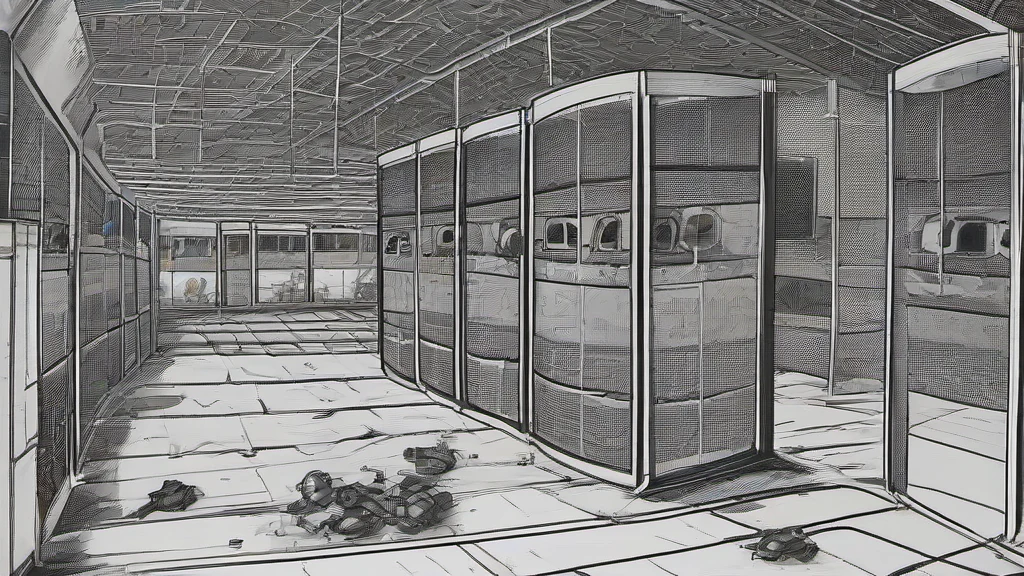
Vincenzo Natali’s Cube opens with a man waking inside a strange room connected to a series of identical chambers. After crawling through a hatch, he is killed by a wire trap. The scene lasts about three minutes and uses no dialogue, introducing the film’s premise through its stark setting and sudden violence.
The 1997 Canadian independent film follows a group of strangers who do not know how they were brought to the structure or why they were chosen. The main characters include Leaven, a student with a talent for mathematics; Quentin, a police officer; Worth, a man who wants to give up; Holloway, a doctor; and Rennes, an escape artist. After Rennes dies while testing a room, the group searches for a safer way to navigate the maze.
Leaven studies the numbers marked on the hatches and initially concludes that rooms with prime-numbered labels contain traps. The group later discovers that the structure consists of 17,576 smaller cubes, and that the labels are connected to the rooms’ Cartesian coordinates. Mathematician David W. Pravica designed the Cube and consulted on the production. The film’s mathematical ideas have since been examined by viewers, though the review argues that the story does not maintain the same degree of mathematical rigor throughout.
Natali conceived the film as a low-cost project built around a limited set, drawing inspiration from Alfred Hitchcock’s Lifeboat. He had developed the script for several years and made the short horror film Elevated before directing Cube. Screenwriters André Bijelic and Graeme Manson helped revise and streamline the screenplay. The production received support from the Canadian Feature Film Fund, and Toronto film community members contributed special-effects work.
The production used one complete cube set and part of a second, with colored gel panels changed to alter the rooms’ lighting. The nearby railway tracks became part of the film’s soundscape. Cinematographer Derek Rogers used different lenses and close-ups to convey the characters’ fear and suggest the scale of the maze, while the sound design heightens tension in a scene involving a sound-triggered trap.
The film’s central mystery remains unresolved: the characters never learn who built the Cube or what its purpose is. The review praises the claustrophobic setting, gruesome traps and decision to leave the premise unexplained, while finding that some of the characters’ theories and reactions are not developed convincingly. Despite those reservations, it describes Cube as an enjoyable horror film with memorable gore and an unusual focus on mathematical problem-solving.
Sources: Reactor.